Projects and Innovation
The Artificial Intelligence and Adaptive Systems Research Group develops applied AI systems and platforms that support learning, employability, and intelligent decision-making. Our work combines academic research, platform development, and interdisciplinary collaboration to produce real-world impact through publications, innovation outputs, industry engagement, and translational research.
 MetaNode: AI-Driven Workflow Intelligence and Adaptive Learning
MetaNode is a research-led platform focused on the design and deployment of AI-driven workflow intelligence systems for modern organisations. It explores how business processes can be represented as deterministic graphs of tasks, enabling structured execution, system integration, and continuous optimisation.
At its core, MetaNode investigates the convergence of process engineering, artificial intelligence, and adaptive learning. Workflows are not only executed across internal systems, external services, and AI models, but also serve as the foundation for generating context-aware learning experiences. This allows knowledge to be embedded directly within operational processes, rather than delivered as separate, static training.
A key research contribution of MetaNode lies in its closed-loop architecture, where process execution, user engagement, and learning are continuously monitored and refined. Interaction data is used to dynamically adapt learning pathways, improve task performance, and support evidence-based decision-making.
At the core of MetaNode is a closed-loop system where engagement drives capability, capability drives execution, and execution delivers measurable ROI.
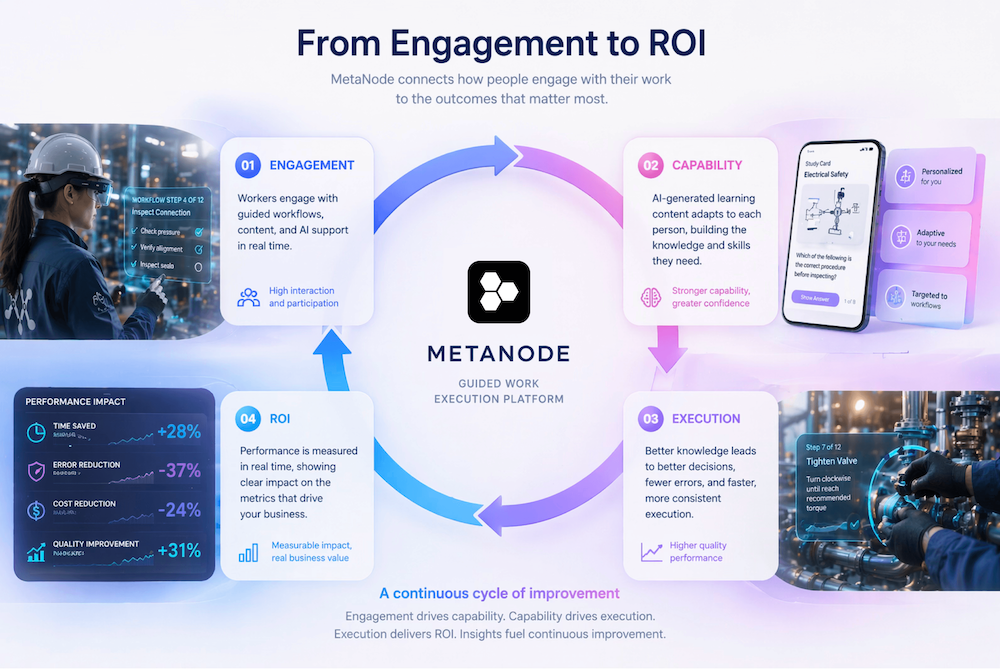
The platform also supports ongoing work in analytics and impact modelling, with a focus on linking engagement and performance data to measurable organisational outcomes. This enables the exploration of real-time return on investment (ROI) for both operational processes and learning interventions.
MetaNode serves as both a research testbed and a deployed system, underpinning projects in enterprise learning, workflow automation, and intelligent systems integration. It provides a foundation for collaboration with industry partners and supports research in areas such as human-AI interaction, process optimisation, and adaptive systems design.
Focus Areas
- Personalised corporate learning
- Adaptive course generation
- Skills development and workforce capability
- Workflow-based learning environments
Project Status
Live / active development
Funding
This work is supported by the Enterprise Ireland Commercialisation Fund Programme through project CF-2024-2363-I.
Project Links
 AI-Supported Academic Workflow and Pedagogical Intelligence
STUDI is a research-led platform focused on rethinking how students engage with learning in an AI-native environment. It explores how academic workflows—from discovery through to assessment—can be supported by intelligent systems that guide, adapt, and respond to individual student needs in real time.
At its core, STUDI integrates federated academic search, adaptive learning, and AI-governed pedagogical tutoring to support students throughout their learning journey. Rather than treating artificial intelligence as an external tool, the platform embeds AI directly within structured learning processes, enabling students to work with AI in a guided and pedagogically grounded way.
A key research contribution of STUDI lies in its ability to structure the student learning experience as a continuous, supported workflow. Students move from discovery and engagement through to guided interaction and feedback, with AI systems providing scaffolded support that adapts to their progress, behaviour, and understanding.
At the core of STUDI is a structured learning workflow where discovery drives engagement, engagement drives guided learning, and guided learning supports continuous progression and confidence.
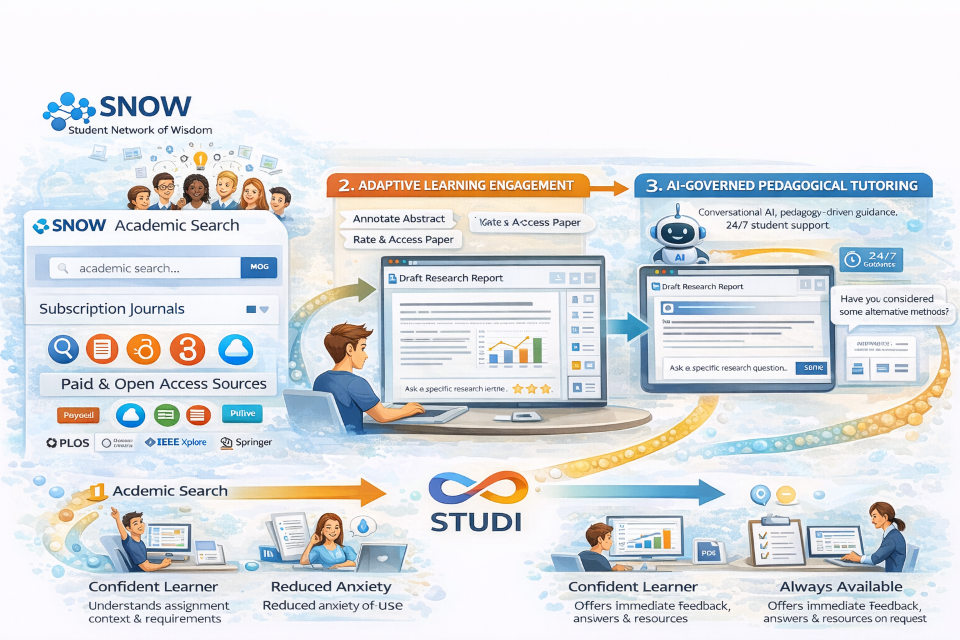
This model underpins how STUDI supports students in working with AI as part of a guided, pedagogically grounded learning process.
On the institutional side, STUDI integrates with the MENTO framework to enable educators to design, deploy, and monitor AI-supported pedagogical workflows. Lecturers can create discipline-specific pedagogy bots, embed them within assessments, and track student engagement and performance in real time.
This approach enables the identification of struggling students, supports targeted intervention, and introduces new mechanisms for verifying authentic learning. By embedding AI within the assessment process, STUDI helps address challenges related to academic integrity, reducing opportunities for plagiarism and supporting evidence-based evaluation of student work.
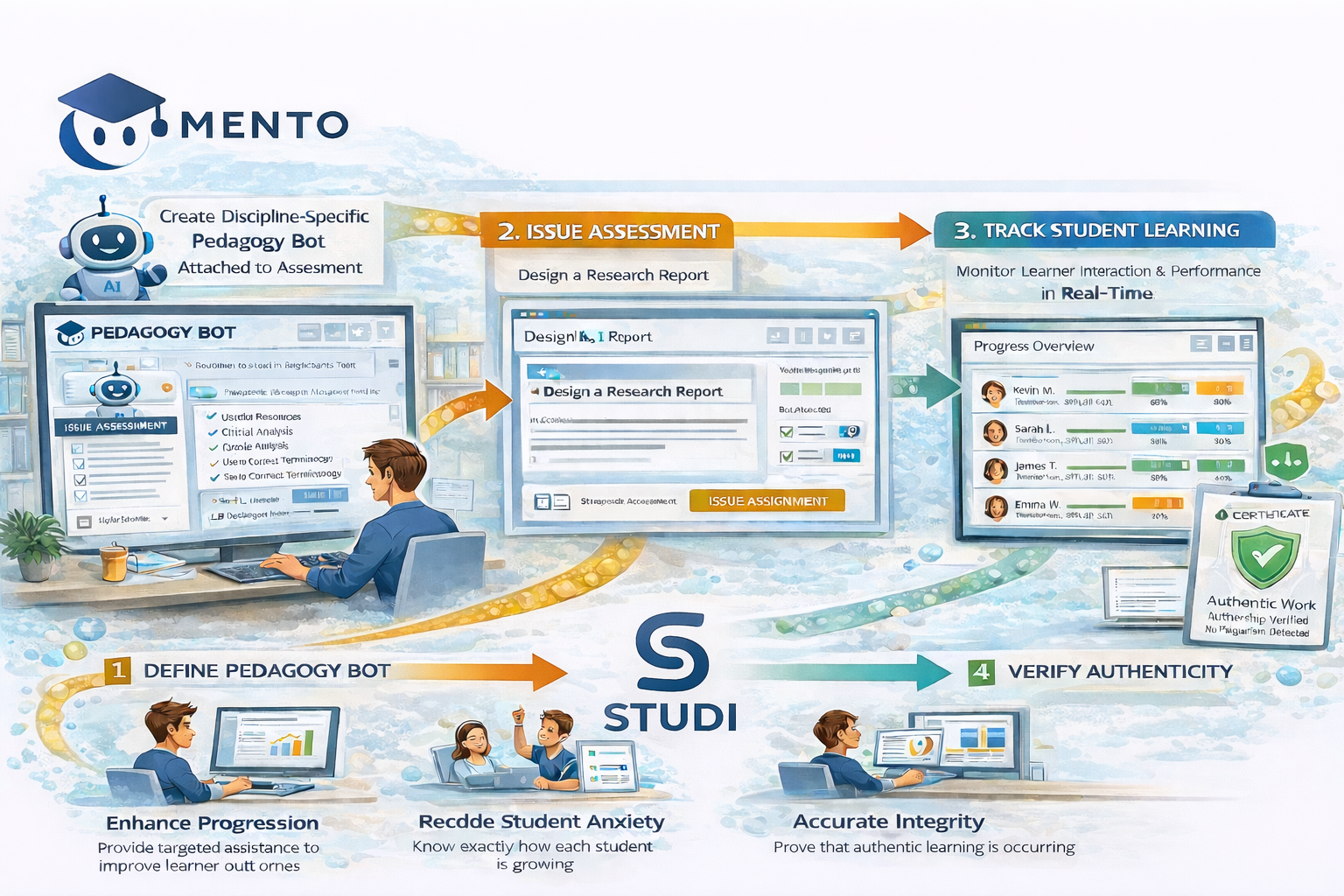
The platform also supports ongoing research in learning analytics, student engagement, and academic integrity, with a focus on understanding how AI can be used to enhance, rather than undermine, the learning process. STUDI provides a foundation for exploring new models of assessment, feedback, and personalised learning in higher education.
Core Research Areas
- Student engagement and motivation
- Personalised and adaptive learning systems
- AI-supported pedagogy and tutoring
- Authentic assessment and academic integrity
Project Status
Active research and development
Funding
(To be added)
Project Links
STUDI is available as a live platform and research testbed:
Explore the platform —
 EngageSLT: AI-Supported Speech and Language Intervention Platform
EngageSLT is a research-led platform focused on improving access to speech and language therapy through the use of intelligent systems and user-centred design. It addresses the growing demand for early intervention by exploring how digital platforms can support children, families, and therapists in delivering effective, scalable therapy solutions.
Speech, language, and communication needs represent one of the most prevalent childhood disabilities, with significant long-term impacts on education, employment, and social inclusion. Despite the proven effectiveness of speech and language therapy, access remains limited due to capacity constraints and extensive waiting lists. EngageSLT investigates how technology can bridge this gap by supporting therapy delivery beyond traditional clinical settings.
At its core, EngageSLT integrates structured therapy pathways, interactive digital content, and intelligent feedback mechanisms to support children’s development in a consistent and engaging manner. The platform enables therapy activities to be delivered in home and educational environments, while maintaining alignment with clinical goals and best practice.
A key research contribution of EngageSLT lies in its ability to extend therapy beyond the clinic through a continuous support model. Parents, educators, and therapists are connected through a shared platform, enabling ongoing engagement, monitoring, and adaptation of therapy activities based on individual progress.
At the core of EngageSLT is a supported intervention model where structured therapy drives engagement, engagement supports skill development, and continuous feedback enables measurable progress in speech and language outcomes.
This model underpins how EngageSLT extends therapy beyond clinical settings, enabling continuous, accessible, and personalised intervention.*
The platform supports ongoing research in digital health, assistive technologies, and early intervention, with a focus on improving accessibility, reducing waiting times, and enhancing long-term developmental outcomes. EngageSLT provides a foundation for collaboration between clinicians, researchers, and technology developers in the design of scalable therapy systems.
Core Research Areas
- Speech and language therapy
- Digital health and assistive technologies
- Intelligent systems for intervention
- User-centred design and accessibility
Project Status
Active research and development
Funding
This project was funded through the EU Commission Recovery and Resilience Facility under the Science Foundation Ireland OurTech Challenge, grant number 22/NCF/OT/11328.
Project Links
EngageSLT is available as a digital platform and research initiative:
Explore EngageSLT
Resourceful
Research Translation
A central objective of the group is the translation of research into practical and measurable impact. We develop applied AI systems that support learning, employability, and intelligent decision-making, with a particular emphasis on building platforms and prototypes that can scale beyond the university setting.
Our research translation activities include: - development of intelligent platforms and applied systems - interdisciplinary collaboration with academic and industry partners - generation of publications and innovation outputs - exploration of patents and commercialisation opportunities - creation of sustainable pathways from research to deployment
This translational approach ensures that the group’s research contributes not only to scholarly knowledge, but also to tangible improvements in education, work, and society.